
EPA 608 Type I vs Type II vs Type III (2026 Guide)
Compare EPA 608 Type I vs Type II vs Type III: equipment covered, exam difficulty, career impact. See why 77% of HVAC techs choose Universal certification.
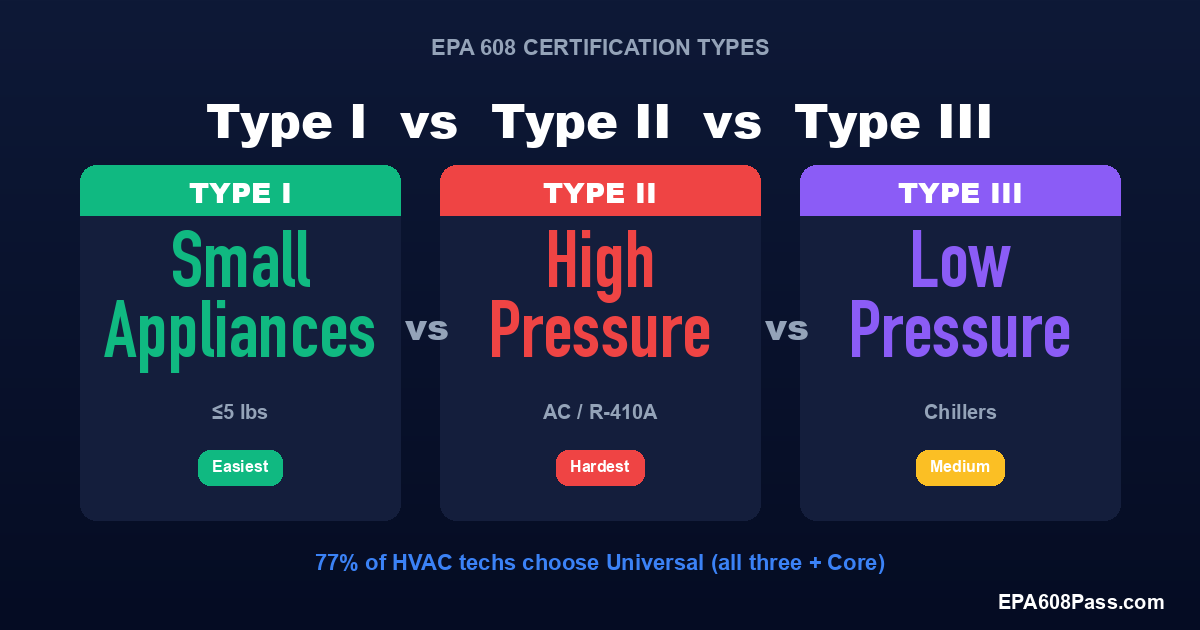
Choosing between EPA 608 Type 1 vs Type 2 vs Type 3 comes down to one question: what equipment will you work on? Type I covers small appliances, Type II covers high-pressure systems (residential and commercial AC), and Type III covers low-pressure chillers. This guide breaks down every difference between EPA 608 Type 1 vs Type 2 vs Type 3 — equipment, exam difficulty, career impact, and whether Universal certification is worth it.
TL;DR — EPA 608 Type 1 vs Type 2 vs Type 3
Type I = small appliances (≤5 lbs). Type II = high-pressure systems (residential/commercial AC). Type III = low-pressure chillers. Universal = all three + Core. Most HVAC technicians should get Universal — it costs the same and opens every door. Comparing EPA 608 Type 1 vs Type 2 vs Type 3, Type II is the hardest and most career-relevant.
SIDE-BY-SIDE COMPARISON
EPA 608 Type I vs Type II vs Type III
Pressure
Any (≤5 lbs charge)
Equipment
- •Household refrigerators
- •Window AC units
- •Vending machines
- •Dehumidifiers
Refrigerants
R-134a, R-600a, R-404A
Recovery
90% (comp. ON) / 80% (comp. OFF)
Pressure
High / Very High Pressure
Equipment
- •Residential central AC
- •Heat pumps
- •Commercial refrigeration
- •R-410A / A2L systems
Refrigerants
R-22, R-410A, R-454B, R-32
Recovery
0 psig (>200 lbs) / 10" Hg (<200 lbs)
Pressure
Low Pressure
Equipment
- •Centrifugal chillers
- •Industrial chillers
- •R-123 systems
- •Large commercial buildings
Refrigerants
R-123, R-11, R-245fa
Recovery
25 mm Hg absolute
What Is EPA 608 Type I Certification?
In the EPA 608 Type 1 vs Type 2 vs Type 3 comparison, Type I is the narrowest. It covers small appliances — factory-sealed, hermetically sealed equipment containing 5 pounds or less of refrigerant. Think household refrigerators, window air conditioners, dehumidifiers, and vending machines.
Type I is the only certification level with an open-book mail-in option (84% passing score vs. 72% proctored). It is also the easiest section on the exam — most technicians can pass with minimal study. The key numbers to memorize: 90% recovery when the compressor operates, 80% when it does not.
Practice for the Type I section with our Type I practice questions.
What Is EPA 608 Type II Certification?
Type II is where most HVAC careers live. In the EPA 608 Type 1 vs Type 2 vs Type 3 breakdown, Type II covers high-pressure and very high-pressure systems — residential central air conditioning, heat pumps, mini-splits, commercial refrigeration units, and supermarket display cases.
Type II has the highest fail rate of all four EPA 608 sections. The exam heavily tests leak rates (10% comfort cooling, 20% commercial refrigeration, 30% industrial process), evacuation levels, and R-410A / A2L refrigerant properties. If you are comparing EPA 608 Type 1 vs Type 2 vs Type 3 by difficulty, Type II is the hardest — plan extra study time here.
The 2026 transition to A2L refrigerants (R-454B, R-32) falls squarely within Type II territory. Your existing Type II certification covers these new refrigerants — no re-certification required. Practice with our Type II practice questions.
LEAK RATES (KEY FOR TYPE II)
Leak Repair Thresholds by Category
Commercial Refrigeration
Repair window: 30 days
Applies to: ≥50 lbs
Comfort Cooling (AC)
Repair window: 30 days
Applies to: ≥50 lbs
Industrial Process Refrigeration
Repair window: 30 days
Applies to: ≥50 lbs
* Memorize 10/20/30 — Comfort/Commercial/Industrial. Always appears on the Type II exam.
What Is EPA 608 Type III Certification?
In the EPA 608 Type 1 vs Type 2 vs Type 3 lineup, Type III is the most specialized. It covers low-pressure systems — primarily centrifugal chillers used in large commercial buildings, hospitals, universities, and industrial facilities. These systems use refrigerants like R-123, R-11, and R-245fa that operate below atmospheric pressure.
Type III is niche: if you study chillers, you pass. The exam focuses on purge units, rupture disks (15 psig burst pressure), the 25 mm Hg absolute evacuation level, and the fact that R-123 systems operate in a vacuum. A common exam trap: R-12 is NOT a low-pressure refrigerant despite having a similar naming convention.
Prepare with our Type III practice questions.
Which EPA 608 Type Do You Need?
When comparing EPA 608 Type 1 vs Type 2 vs Type 3 for your career, the answer depends on what equipment you will service. But for most technicians, the real question is not "which individual type?" — it is "should I just get Universal?"
WHICH DO YOU NEED?
Choose Your EPA 608 Certification by Role
Appliance repair technician
Refrigerators, freezers, window ACs only
of techs
Residential HVAC technician
Central AC, heat pumps, mini-splits
of techs
Chiller / industrial technician
Centrifugal chillers, low-pressure systems
of techs
Field HVAC technician (most common)
Any equipment, maximum employability
of techs
* Estimated percentages based on U.S. HVAC job posting requirements.
Why Universal Is Almost Always the Right Choice
When technicians compare EPA 608 Type 1 vs Type 2 vs Type 3, many plan to get just the type they need right now. This is usually a mistake. Here is why Universal certification is almost always the better path:
- Same exam fee — Universal costs the same as any single type ($10–90 depending on provider). You take all four sections in one sitting.
- Most job postings require it — An estimated 77% of HVAC field service positions list Universal as a minimum requirement.
- One-and-done — Your Core result counts for everything. If you get Type II first and want to add Type III later, you may need to retake Core depending on the provider.
- Career flexibility — You never know when you will need to service a different type of equipment. Universal means you never have to turn down a job because of certification limitations.
COST: UNIVERSAL VS STEP-BY-STEP
Is It Cheaper to Get Universal All at Once?
EPA 608 Type 1 vs Type 2 vs Type 3: Exam Comparison
All three sections follow the same format — 25 multiple-choice questions each, with a passing score of 72% (18/25). But the content and difficulty vary significantly across EPA 608 Type 1 vs Type 2 vs Type 3:
| Factor | Type I | Type II | Type III |
|---|---|---|---|
| Questions | 25 | 25 | 25 |
| Passing | 18/25 (72%) | 18/25 (72%) | 18/25 (72%) |
| Difficulty | Easiest | Hardest | Medium |
| Study time | 2–3 days | 5–7 days | 3–4 days |
| Open book? | ✓ (mail-in) | ✗ | ✗ |
| Key topic | 90/80% recovery | Leak rates 10/20/30% | 25 mm Hg evacuation |
2026 Update: A2L Refrigerants and EPA 608 Types
As of January 1, 2026, all new residential HVAC systems must use A2L refrigerants (R-454B, R-32) instead of R-410A. This directly impacts the EPA 608 Type 1 vs Type 2 vs Type 3 discussion because A2L systems fall under Type II certification.
No new EPA 608 certification type was created for A2L refrigerants. Your existing Type II or Universal certification covers all A2L work. However, employers may require additional safety training because A2L refrigerants are mildly flammable — a characteristic that R-410A did not have.
Frequently Asked Questions
What is the difference between EPA 608 Type 1, Type 2, and Type 3?
EPA 608 Type 1 vs Type 2 vs Type 3 differs by equipment: Type I covers small appliances (≤5 lbs refrigerant), Type II covers high-pressure systems (residential/commercial AC), and Type III covers low-pressure systems (centrifugal chillers). Universal certification combines all three plus the Core section.
Is EPA 608 Type 2 harder than Type 1?
Yes. Type II has the highest fail rate of all EPA 608 sections. It covers more complex topics including leak rate thresholds, evacuation levels, and high-pressure refrigerant properties. In the EPA 608 Type 1 vs Type 2 vs Type 3 comparison, Type I is the easiest and Type II is the hardest.
Can I get EPA 608 Type 2 without Type 1?
Yes. You can test for any individual type without passing the others first. However, all types require passing the Core section. Getting Universal (all types at once) costs the same and gives you more flexibility — there is no reason to skip types unless you only need one specific certification.
Which EPA 608 type do most HVAC technicians get?
Most HVAC technicians get Universal certification, which includes all three types. An estimated 77% of HVAC job postings require Universal. When comparing EPA 608 Type 1 vs Type 2 vs Type 3 individually, Type II is the most career-relevant because it covers the equipment most technicians encounter daily.
Does EPA 608 Type 3 cover R-410A?
No. R-410A is a high-pressure refrigerant covered under Type II. Type III covers low-pressure refrigerants like R-123 and R-11 used in centrifugal chillers. This is a common confusion in the EPA 608 Type 1 vs Type 2 vs Type 3 breakdown — pressure class determines the type, not the refrigerant number.
Related Articles
Ready to Practice for All Types?
Our free practice test covers Core, Type I, Type II, and Type III — the same sections on the real Universal exam. See exactly which areas you need to study before exam day.
Take the Free Practice Test