
HVAC Certifications You Need in 2026 (Complete List)
Every HVAC certification ranked: EPA 608, NATE, state licenses, A2L training, OSHA. Costs, renewal, career path from $30K entry to $85K senior tech.
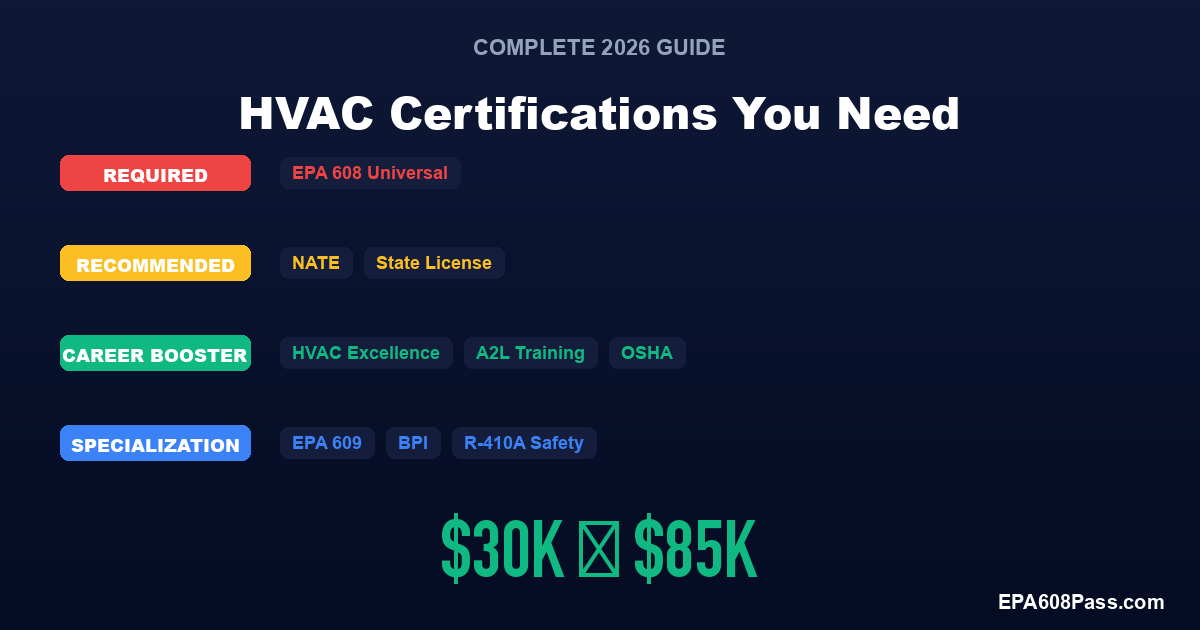
What HVAC certifications 2026 do you actually need? There are over a dozen credentials in the HVAC industry, but only a few are legally required — the rest are career boosters that increase your pay and open doors to better jobs. This guide ranks every HVAC certification by importance, covers costs and renewal requirements, maps out the career pathway from entry-level to senior tech, and highlights what changed in 2026.
TL;DR — HVAC Certifications 2026
Only EPA 608 Universal is federally required ($10–90, permanent). Your state HVAC license is required in most states (renews every 1–3 years). NATE certification is the top career booster ($150–250, adds $2–5/hr). New for 2026: employer-mandated A2L training by June, HFC leak repair rules expanded. Total minimum cost to start: $60.
TIER LIST
All HVAC Certifications Ranked by Importance
Federally required by law to handle refrigerants
Renewal: Never — permanent
Preferred by most employers. Increases pay $2–5/hr
Renewal: Every 5 years (CEUs)
Required in most states for field work
Renewal: Every 1–3 years
Demonstrates advanced competency. Good for supervisor roles
Renewal: Every 5 years
Employer-mandated by Jun 2026. Covers flammability safety
Renewal: Varies by employer
Safety certification specific to high-pressure R-410A
Renewal: None
For vehicle AC. Needed if you also work on cars
Renewal: Never — permanent
Workplace safety. Many employers require it
Renewal: None (recommended every 5 years)
Residential energy audits. High-demand niche
Renewal: Every 3 years
The Only Required HVAC Certification: EPA 608
Among all HVAC certifications 2026, EPA 608 Universal is the only one required by federal law. Under Section 608 of the Clean Air Act, any technician who purchases, handles, or services equipment containing regulated refrigerants must hold EPA 608 certification. Working without it is a federal violation carrying fines up to $44,539 per day.
EPA 608 Universal covers all equipment types — small appliances (Type I), high-pressure systems like residential AC (Type II), and low-pressure chillers (Type III). It costs $10–90, never expires, and can be taken online from home. If you do not have it yet, this is your first priority among all HVAC certifications 2026. Get started with our free practice test.
State HVAC Licenses
The second most important credential in the HVAC certifications 2026 list is your state license. Most states require HVAC technicians and contractors to hold a state-issued license to perform field work. Unlike EPA 608, state licenses expire — typically every 1–3 years — and require continuing education credits for renewal.
State licensing requirements vary significantly. Some states (like Texas, Florida, California) have strict requirements with multiple license levels. Others have minimal requirements or no state license at all (though local jurisdictions may still require one). Check your state HVAC licensing board for specifics. The key distinction: EPA 608 is federal and never expires; your state license is separate and does expire.
NATE Certification: The Top Career Booster
NATE (North American Technician Excellence) is the most recognized voluntary certification in the HVAC certifications 2026 landscape. NATE-certified technicians typically earn $2–5 more per hour than non-certified peers, and most large HVAC companies list NATE as a preferred or required qualification.
NATE offers specialty certifications in air conditioning, heat pumps, gas furnaces, and HVAC efficiency analysis. Each certification is valid for 5 years and requires continuing education units (CEUs) or re-examination for renewal. Cost: $150–250 per specialty exam.
HVAC Certifications by Career Stage
Not all HVAC certifications 2026 need to be earned at once. Here is the order that makes the most sense for your career, from entry-level to senior technician:
CAREER PATH
HVAC Certifications by Career Stage
0–6 months
6–18 months
2–4 years
5+ years
What Changed in 2026
The HVAC certifications 2026 landscape has several important updates compared to previous years. These changes affect what training you need and how you service equipment:
WHAT'S NEW IN 2026
4 HVAC Certification Changes for 2026
Systems with ≥15 lbs HFC now require mandatory leak detection and repair
Employers must document HFC emissions reduction training for their technicians
All new residential equipment uses A2L. Servicing existing R-410A remains legal
NATE exams now include A2L refrigerant questions and safety procedures
Complete Cost Summary
Here is every HVAC certification with its cost, renewal schedule, and whether it is legally required. The minimum investment to start working in HVAC is just $60 (EPA 608 + basic state license):
COST SUMMARY
Every HVAC Certification: Cost and Renewal
| Certification | Cost | Expires | Required? |
|---|---|---|---|
| EPA 608 Universal | $10–90 | Never | ✓ |
| EPA 609 (MVAC) | $20–30 | Never | — |
| State HVAC license | $50–500 | 1–3 years | ✓ |
| NATE | $150–250 | 5 years | — |
| HVAC Excellence | $100–200 | 5 years | — |
| A2L Training | $0–100 | Varies | — |
| OSHA 10 | $0–100 | Recommended 5 years | — |
| OSHA 30 | $100–200 | Recommended 5 years | — |
| BPI | $200–400 | 3 years | — |
Minimum cost to start: EPA 608 ($10) + state license ($50) = $60
Certifications That Are NOT Required (But People Think They Are)
Some credentials in the HVAC certifications 2026 discussion get confused with legal requirements:
- NATE is not legally required — It is an industry credential, not a government mandate. Excellent for career growth, but you can legally work without it.
- R-410A safety certification is not federally required — Some employers require it as company policy, but there is no federal law mandating it.
- A2L training is employer-mandated, not EPA-mandated — The June 2026 deadline is for employers to provide training, not for technicians to pass a new exam.
- OSHA 10/30 is not universally required — Some states and employers require it, but it is not a federal HVAC requirement.
Frequently Asked Questions
What HVAC certifications do I need in 2026?
At minimum: EPA 608 Universal (federally required) and your state HVAC license (required in most states). For career advancement, add NATE certification. The complete HVAC certifications 2026 list includes EPA 608, state license, NATE, HVAC Excellence, A2L training, OSHA 10/30, EPA 609, and BPI.
How much do all HVAC certifications cost?
The minimum to start is $60 (EPA 608 at $10 + state license at ~$50). Getting all major HVAC certifications 2026 costs $500–1,500 total. The best ROI is EPA 608 Universal ($10–90, permanent, required) followed by NATE ($150–250, adds $2–5/hr).
Which HVAC certification pays the most?
NATE certification has the highest direct salary impact among HVAC certifications 2026, adding $2–5/hr ($4K–10K/year). EPA 608 does not directly increase pay but is required to work in the field at all — without it, your earning potential is $0 in HVAC.
Do HVAC certifications expire?
EPA 608 and EPA 609 never expire. State licenses expire every 1–3 years. NATE expires every 5 years. HVAC Excellence expires every 5 years. BPI expires every 3 years. Among HVAC certifications 2026, only the two EPA certifications are truly permanent.
Can I get HVAC certified online?
EPA 608 can be taken entirely online through 16+ EPA-approved providers. NATE exams are available at Pearson VUE testing centers. State license requirements vary — some allow online testing, others require in-person. Most HVAC certifications 2026 have at least partial online options.
Related Articles
Start With EPA 608 — The #1 Required Certification
Every HVAC career starts with EPA 608. Free study guide, free flashcards, free practice test — pass the exam for as little as $10.