
R-410A vs R-22: What HVAC Techs Must Know (2026)
R-410A vs R-22 explained: ODP, GWP, pressures, oils, phasedown timeline. Both being replaced by A2L refrigerants. No EPA recertification needed.
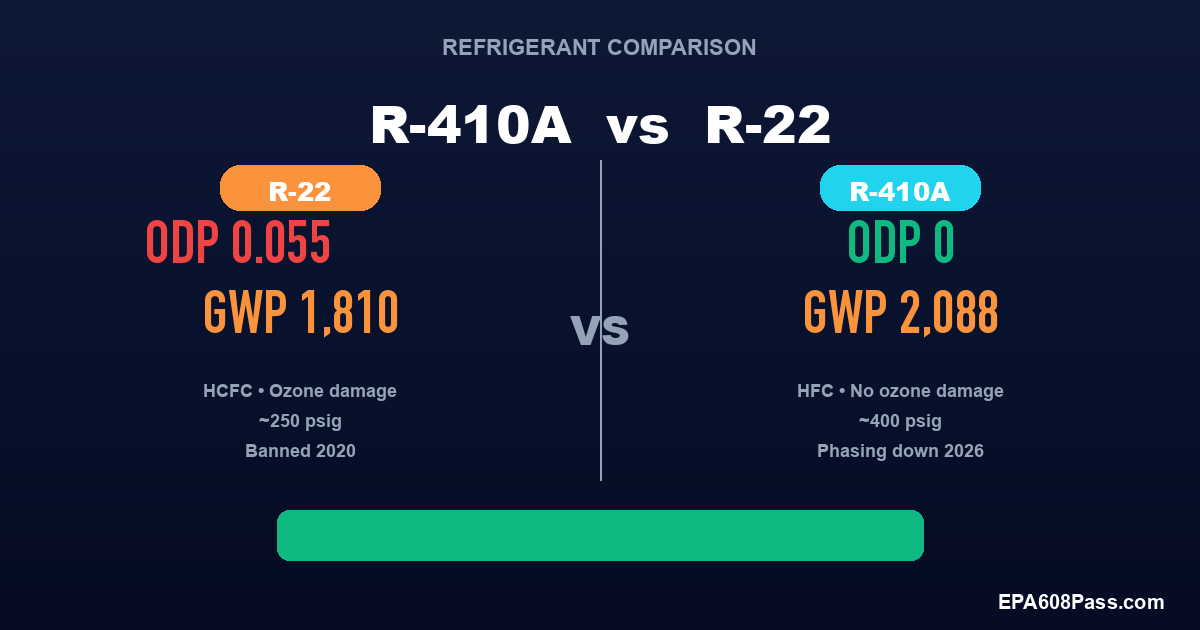
R-410A vs R-22 is the refrigerant transition every HVAC technician must understand in 2026. R-22 (Freon) production was banned in 2020. R-410A (Puron) is now being phased down in new residential equipment, replaced by A2L refrigerants like R-454B and R-32. This guide covers every technical difference between R-410A vs R-22, the complete phasedown timeline, what replaces them, and what it all means for your EPA 608 certification.
TL;DR — R-410A vs R-22
R-22: HCFC, damages ozone, banned since 2020, only reclaimed supply left. R-410A: HFC, no ozone damage but high GWP (2,088), no longer in new residential systems since 2026. Both being replaced by A2L refrigerants (R-454B, R-32) with much lower GWP. Your existing EPA 608 certification covers all of them — no recertification needed.
TECHNICAL SPECS
R-410A vs R-22: Complete Technical Comparison
| R-22 (Freon) | R-410A (Puron) | |
|---|---|---|
| Chemical type | HCFC | HFC (blend of R-32 + R-125) |
| ODP | 0.055 | 0 |
| GWP | 1,810 | 2,088 |
| Operating pressure | ~250 psig | ~400 psig |
| Oil type | Mineral oil | POE (synthetic polyester) |
| New production? | No — banned since 2020 | No in new equipment since 2026 |
| Available for service? | Reclaimed/recycled only | Yes — production continues for servicing |
| Flammable? | No (A1) | No (A1) |
| Mixable? | NO — never mix | NO — never mix |
What Is R-22 (Freon)?
In the R-410A vs R-22 comparison, R-22 is the older refrigerant. Also known by the brand name Freon, R-22 is a hydrochlorofluorocarbon (HCFC) that was the standard refrigerant in residential and commercial AC systems for decades. The chlorine in R-22 damages the ozone layer (ODP of 0.055), which led to its phaseout.
Key facts about R-22: it operates at approximately 250 psig, uses mineral oil as a lubricant, and cannot be mixed with R-410A under any circumstances. New R-22 production was completely banned on January 1, 2020. Only reclaimed and recycled R-22 is available for servicing existing systems.
What Is R-410A (Puron)?
R-410A is the replacement that dominated the R-410A vs R-22 transition starting in 2010. Also known as Puron, R-410A is a hydrofluorocarbon (HFC) blend of R-32 and R-125. It has zero ozone depletion potential (ODP 0), which solved the ozone problem — but its high global warming potential (GWP 2,088) created a new environmental concern.
R-410A operates at significantly higher pressure (~400 psig vs. ~250 psig for R-22), requires POE synthetic oil, and delivers better heat transfer efficiency. Equipment designed for R-22 cannot use R-410A — the higher pressure would rupture components designed for R-22.
R-410A vs R-22: Why Both Are Being Phased Out
Understanding why both refrigerants in the R-410A vs R-22 comparison are being eliminated requires knowing the difference between ODP and GWP:
- R-22 was phased out because of ODP — Its chlorine content destroys stratospheric ozone. The Montreal Protocol mandated the phaseout of all HCFCs, with R-22 production ending in 2020.
- R-410A is being phased down because of GWP — While it does not damage the ozone layer, R-410A has a GWP of 2,088 (meaning it traps 2,088 times more heat than CO₂). The AIM Act of 2020 targets HFCs with high GWP for gradual reduction.
The R-410A vs R-22 story is really two waves of environmental regulation: first ozone protection (killing R-22), then climate protection (killing R-410A). The replacements — A2L refrigerants — solve both problems with zero ODP and dramatically lower GWP.
TIMELINE
R-22 & R-410A Phaseout: Complete Timeline
What Replaces R-410A? A2L Refrigerants Explained
Beyond the R-410A vs R-22 comparison, the next generation is already here. A2L refrigerants are classified as "mildly flammable" (ASHRAE safety group A2L) with significantly lower GWP:
- R-454B (Opteon XL41) — GWP 466, primary replacement for R-410A in U.S. residential systems. Used by Carrier, Trane, and others.
- R-32 — GWP 675, widely used globally (especially in Asia). Daikin and Mitsubishi use R-32 extensively. Single-component refrigerant (not a blend), making recycling easier.
- R-1234yf — GWP 4, used primarily in automotive AC (EPA 609 territory, not 608).
ENVIRONMENTAL IMPACT
GWP by Refrigerant — Why We're Switching
* GWP = Global Warming Potential (vs CO₂ = 1). Lower = better for the environment.
What HVAC Technicians Must Know in 2026
The R-410A vs R-22 transition directly impacts your daily work and your EPA 608 exam. Here are the five questions every technician should be able to answer:
FOR TECHNICIANS
5 Questions Every HVAC Tech Must Answer
Do I need new certification for A2L?
No. Your EPA 608 Type II or Universal covers all A2L refrigerants. No new category was created.
Can I still service R-22 systems?
Yes — using reclaimed/recycled R-22 is legal. Only new production was banned.
Can I mix R-22 with R-410A?
NEVER. Different pressures, different oils, different properties. Mixing = destroying the system.
Can I retrofit R-22 to R-410A?
Almost never recommended. Requires replacing compressor, evaporator, condenser, and copper lines. Usually better to replace the entire system.
Are A2L refrigerants dangerous?
They are mildly flammable (A2L = lower flammability). Specific tools and procedures needed, but risk is manageable with training.
R-410A vs R-22 on the EPA 608 Exam
The R-410A vs R-22 topic appears heavily in the Type II section of the EPA 608 exam. Key exam points to memorize:
- R-22 is an HCFC with ODP — R-410A is an HFC with zero ODP
- Never mix refrigerants — R-22 and R-410A use different oils and operate at different pressures
- R-410A operates at higher pressure — Equipment is not interchangeable
- Leak rates — 10% comfort cooling, 20% commercial, 30% industrial (applies to both refrigerants)
- Recovery requirements — Both must be recovered before service; venting is illegal
- GWP comparison — R-22 GWP is 1,810; R-410A GWP is 2,088; A2L alternatives are 466–675
Study our refrigerant cheat sheet for all the numbers you need to memorize. Then test yourself with our Type II practice questions.
Can You Retrofit R-22 to R-410A?
In the R-410A vs R-22 debate, retrofit is almost never the right answer. Converting an R-22 system to R-410A requires replacing the compressor, evaporator, condenser, expansion valve, and potentially all copper lines (R-410A requires thicker walls due to higher pressure). By the time you replace all these components, you have essentially built a new system at 80–90% of the cost.
The industry recommendation: service existing R-22 systems with reclaimed R-22 until end-of-life, then replace the entire system with a new A2L unit. Do not retrofit to R-410A in 2026 — you would be installing a refrigerant that is itself being phased down.
Frequently Asked Questions
What is the difference between R-410A and R-22?
R-410A vs R-22: R-22 is an HCFC that depletes the ozone layer (ODP 0.055). R-410A is an HFC with zero ODP but high GWP (2,088). R-410A operates at higher pressure (~400 psig vs ~250), uses POE oil instead of mineral oil, and cannot be mixed with R-22 in any system.
Is R-410A being phased out?
Yes. As of January 1, 2026, R-410A cannot be used in new residential HVAC systems. It is being replaced by A2L refrigerants (R-454B, R-32) with lower GWP. However, R-410A will continue to be produced for servicing existing systems — this is a phasedown, not an immediate ban.
Can you still buy R-22?
Only reclaimed or recycled R-22. New R-22 production was banned in 2020. Technicians with EPA 608 certification can still purchase reclaimed R-22 to service existing systems, but supply is shrinking and prices continue to rise.
Do I need new certification for A2L refrigerants?
No. Your existing EPA 608 Type II or Universal certification covers A2L refrigerants. The EPA did not create a new certification category. Some employers may require additional A2L safety training due to mild flammability, but this is company policy — not a federal requirement.
Which is better, R-22 or R-410A?
In the R-410A vs R-22 performance comparison, R-410A is more efficient at heat transfer and does not damage the ozone layer. However, the question is now moot for new installations — both are being replaced by A2L refrigerants. For existing systems, use whichever refrigerant the system was designed for.
Related Articles
Know Your Refrigerants Before Exam Day
R-410A vs R-22 questions appear on every Type II exam. Our cheat sheet has all the ODP, GWP, and pressure numbers in one page, and the practice test simulates real exam conditions.